Media Unit - Smartboard Lesson
To complete this project, I worked with both an elementary education major and a graduate student in Library Sciences. Together, we formed a ten-day lesson plan focused on 4th grade poetry, drama and prose. My partner and I met weekly with our media coordinator in a virtual teleplace called Open Qwak. During these meeting my partner, media coordinator and I worked together to design a lesson plan and general layout of the unit. Our lesson began to quickly take shape, so we ended our weekly meetings in Open Qwak and began communicating via email and Google Docs. In our lesson, we included three days where children would receive instruction in the library from the media specialist. This time would be used for students to research an author, poet or playwright. Students would then use the information they gathered to write their own poem, drama or work of prose. These works would then be complied into class book using the app StoryKit.
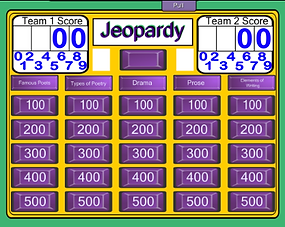
My partner and I also created a Smartboard unit to expand our student's understanding of poetry, drama and prose. This lesson included many engaging activites such as "Let's put dead words to rest" and a jeopardy activity which would serve as a review of our entire unit.
After completing this lesson, my partner and I completed a video using an iPad. During this video, we reflected upon the entire process of completing this project. We both found it to be a great activity to give us experience designing longer lesson plans and Smartboard units.
TO VIEW MY SMARTBOARD UNIT, PLEASE CLICK ON ANY OF THE THREE PAGES TO THE RIGHT.
TO VIEW OUR ACTION TEMPLATE PLEASE CLICK HERE
TO VIEW OUR COLLABORATIVE PLANNING LOG PLEASE CLICK HERE
TO VIEW OUR TEN-DAY LESSON PLAN PLEASE CLICK HERE
TO VIEW MY VIMEO REFLECTION OF THIS ACTIVITY, PLEASE CLICK ON THE PICTURE OF ASHLEY AND I LOCATED TO THE RIGHT.
ISTE Standards
1. Facilitate and inspire student learning and creativity
d. Model collaborative knowledge construction by engaging in learning with students, colleagues, and others in face-to-face and virtual environments
3. Model digital age work and learning
Teachers exhibit knowledge, skills, and work processes representative of an innovative professional in a global and digital society.
b. Collaborate with students, peers, parents, and community members using digital tools and resources to support student success and innovation
d. Model and facilitate effective use of current and emerging digital tools to locate, analyze, evaluate, and use information resources to support research and learning
5. Engage in professional growth and leadership
a. Participate in local and global learning communities to explore creative applications of technology to improve student learning
b. Exhibit leadership by demonstrating a vision of technology infusion, participating in shared decision making and community building, and developing the leadership and technology skills of others
d. Contribute to the effectiveness, vitality, and self- renewal of the teaching profession and of their school and community
NC Professional Teaching Standards:
-
Teachers use a variety of instructional methods.
-
Teachers choose the methods and techniques that are most effective in meeting the needs of their students as they strive to eliminate achievement gaps. Teachers employ a wide range of techniques including information and communication technology, learning styles, and differentiated instruction.
-
Choose methods and materials as they strive to eliminate achievement gaps
-
Employ a wide range of techniques using information and communication technology, learning styles, and differentiated instruction
-
-
-
Teachers integrate and utilize technology in their instruction.
-
Teachers know when and how to use technology to maximize student learning. Teachers help students use technology to learn content, think critically, solve problems, discern reliability, use information, communicate, innovate, and collaborate.
-
Know appropriate use
-
-
Help students use technology to learn content, think critically, solve problems, discern reliability, use information, communicate, innovate, and collaborate
-
Teachers use a variety of methods to assess what each student has learned.
-
Teachers use multiple indicators, including formative and summative assessments, to evaluate student progress and growth as they strive to eliminate achievement gaps. Teachers provide opportunities, methods, feedback, and tools for students to assess themselves and each other. Teachers use 21st century assessment systems to inform instruction and demonstrate evidence of students’ 21st century knowledge, skills, performance, and dispositions.
-
Teachers should:
-
Use multiple indicators,both formativeand summative, to evaluate student progress
-
Provide opportunities for self-assessment
-
Use assessment systems to inform instruction and demonstrate evidence of students’ 21st century knowledge, skills, performance, and dispositions.
-
-